Lesney (Die-Cast) +
Founded in 1947 by Leslie and Rodney.
The company was named using a part of each name to form Lesney and "Products" was used because they were not sure what they would make. The release of the 1st Matchbox was in England in 1953.
New cars were added each year until the series number reached 75
1982: Lesney Products declared bankruptcy on June 11th and decided to rename itself "Matchbox Toys Ltd" their best-known line of toys.
1982: Universal Toys owned by David Yeh bought Matchbox Ltd in September.
1992: Tyco Corporation bought Universal Toys.
1997: Tyco was bought out by Mattel. The brand now is Mattel Tyco R/C division.
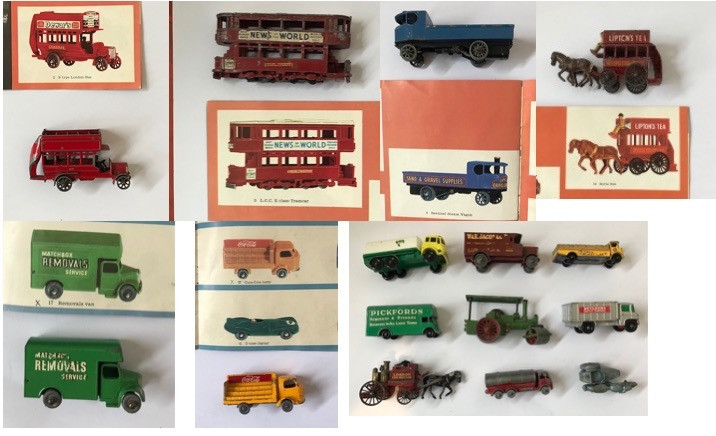
Although the name Lesney became synonymous with Matchbox, the company produced several toys previous to and into the Matchbox era, which were not sold under that famous moniker. Today, these are highly collectible items. They include:
- Road Roller (1947), later scaled down to become Matchbox no. 1*
- Cement Mixer (1948), later scaled down to become Matchbox no. 3*
- Caterpillar Crawler (1948), later scaled down to become Matchbox no. 8
- Caterpillar Bulldozer (1948), later scaled down to become Matchbox no. 18
- Milk Float (1949), later scaled down to become Matchbox no. 7; this was the 1st toy made in Lesley’s second factory at Barrettes Grove
- Soap-Box Racer (1949)
- Rag & Bone Cart (1949)
- Prime Mover & Trailer (1950), used in different scales later as Matchbox 1-75 and Major Pack models
- Jumbo the Elephant (1950), a clockwork toy (marketed by Moko)
- Muffin the Mule (1951), a puppet animal based on a TV show (marketed by Moko)
- Large Royal State Coach (1951 & 1952); the 1st version included figures of king and queen; the horses were cast by competing company Benbros
- Small Royal State Coach [Coronation Coach] (1953), first big seller, provided capital for further ventures
- Massey-Harris Tractor (1954), perhaps the finest Lesney toy, later scaled down to become Matchbox no. 4
- Conestoga Covered Wagon (1954)
Dear Tom
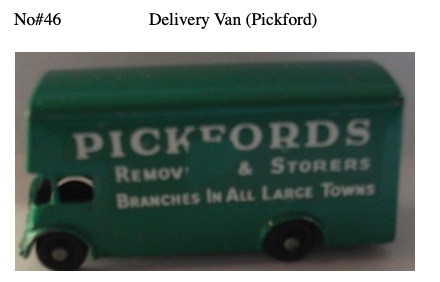
The vehicle you have sent a picture of is a Guy Vixen and was made as the name suggests by the truck Manufacturer Guy in The 1950's The earliest ones were made in 1950.
It had a 4-ton payload - not much you may say compared to today but the maximum payload at the time was only six tons for two axles. Width was 6ft 8 inches and length 22ft. Engine was originally a 4-cylinder petrol engine upgraded in the 50's to a Perkins p4 and then P6 diesel engine. It was standard to the Pickford’s fleet throughout the 50's and 60’s.
Some say even the early Seventies, but I have no proof of this.
The front grill was false - it was fiberglass - just to make the vehicle more aerodynamic - but with the squire luton on top of the cab, this is a bit of a pretentious claim.
They gave great service and even when all over Europe.
The model is a Matchbox model from the sixties. It was produced in green livery with three lines of writing, blue with three lines of writing and blue with two lines of writing. The last one is the most rare and valuable.
Why green - no one is quite sure.
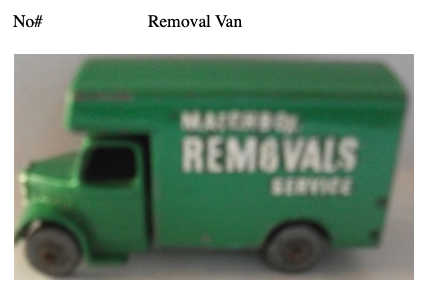
Two ideas - the original removal van in the Matchbox series was a green Bedford and so they just carried on until they realised it should be blue- back in the early twentieth century, some steam lorries were painted green - using ex War Department paint from the first war.
I hope this is of help
Regards: Ashley Jones - International Moving Manager for Pickford’s (15/5/2012)